August 20, 2026 • Kwame Osei-Bonsu • 10 min reading time • Prices verified June 18, 2026
ANNKE DVR vs. Reolink PoE NVR vs. aosu Solar Base Station: Subscription-Free Whole-Home Systems Compared for Real Households
If you’ve been paying $10–$20 a month to a home security camera brand just to see footage from your own cameras, you’ve already done the math: that’s $120–$240 a year, every year, forever — for access to video you technically own. A growing number of homeowners are walking away from that model entirely and building what the industry calls local-storage systems: camera setups that record directly to a hard drive inside your home, with no monthly fee required. This article compares three of the most popular approaches for doing exactly that — the ANNKE DVR (a wired, analog-style system using a digital video recorder), the Reolink PoE NVR (a wired IP camera system where cameras get power and data through a single Ethernet cable, feeding a network video recorder), and the aosu Solar Base Station (a wireless, solar-powered system that records locally without any wiring). By the end, you’ll have a clear decision framework, not a sales pitch.
The subscription-refugee community is real and growing. Security.org’s 2024 report “Home Security Camera Statistics and Trends” notes that subscription fatigue is one of the top-cited reasons homeowners switch camera brands. That context matters for everything that follows.
Who Is Actually Buying These Systems — and Why It Matters for Your Decision
The single most striking pattern in aggregated ANNKE buyer feedback is the explicit “I switched from Blink or Ring” narrative. One representative reviewer put it plainly: “I was sick of paying the subscription and the crappy service” — then went on to praise ANNKE’s infrared night vision as “INSANE and clear.” That emotional framing — escaping a subscription, reclaiming ownership — is not incidental. It tells you something structural about what ANNKE buyers are optimizing for: control, permanence, and long-term cost certainty, even if the installation is more involved.
Reolink PoE NVR buyers skew slightly more technical. They’re comparing resolution specs, evaluating frame rates at night, and thinking about hard drive longevity. Long-term Reolink owners who run all-Reolink camera arrays consistently report multi-year satisfaction — but experienced owners explicitly flag that Reolink NVRs play poorly with third-party camera brands. This is a structural ecosystem fact, not a defect. Reolink’s NVR is engineered for Reolink cameras. If you plan to mix in Hikvision or Dahua cameras down the road, Reolink’s NVR is the wrong hub for that build.
aosu buyers are a different profile again: they’re prioritizing installation simplicity, aesthetic cleanliness (no cable runs), and property types where wiring isn’t practical — rental units, outbuildings, detached garages, and notably, at least one documented church installation. Reviewers consistently mention 15–30 minute installs as a real-world outcome, not a marketing claim.
The decision fork is already visible: If you want maximum image quality and don’t mind a weekend of cable runs, you’re in ANNKE or Reolink territory. If you want to be recording by noon on a Saturday without touching a drill, aosu is worth serious consideration.
System Architecture Compared: Wires, Power, and What You’re Actually Building
ANNKE DVR: The Analog Workhorse
ANNKE’s DVR-based systems use coaxial cable (the same type as older cable TV wiring) to connect cameras to a central recorder. Cameras are powered separately via standard power adapters or a PoC (Power over Coax) system on newer models. The tradeoff is real: coaxial cable is bulkier and less flexible than Ethernet, and running it through finished walls is genuinely harder. But the upside is that coaxial runs can span longer distances than Ethernet without signal degradation, and ANNKE’s HDC (High Definition Composite) camera technology delivers strong image quality — particularly in low-light environments, which is where the “INSANE IR” reviews consistently come from.
ANNKE DVR systems ship with a hard drive bay built into the recorder. You typically supply your own surveillance-grade hard drive (more on sizing below). Footage is stored locally. Remote access is available via ANNKE’s app without a paid subscription — you’re using your home internet connection to reach the recorder.
Lutron
$39.98
In stock on Amazon
Check price on AmazonReolink PoE NVR: The Clean IP Build
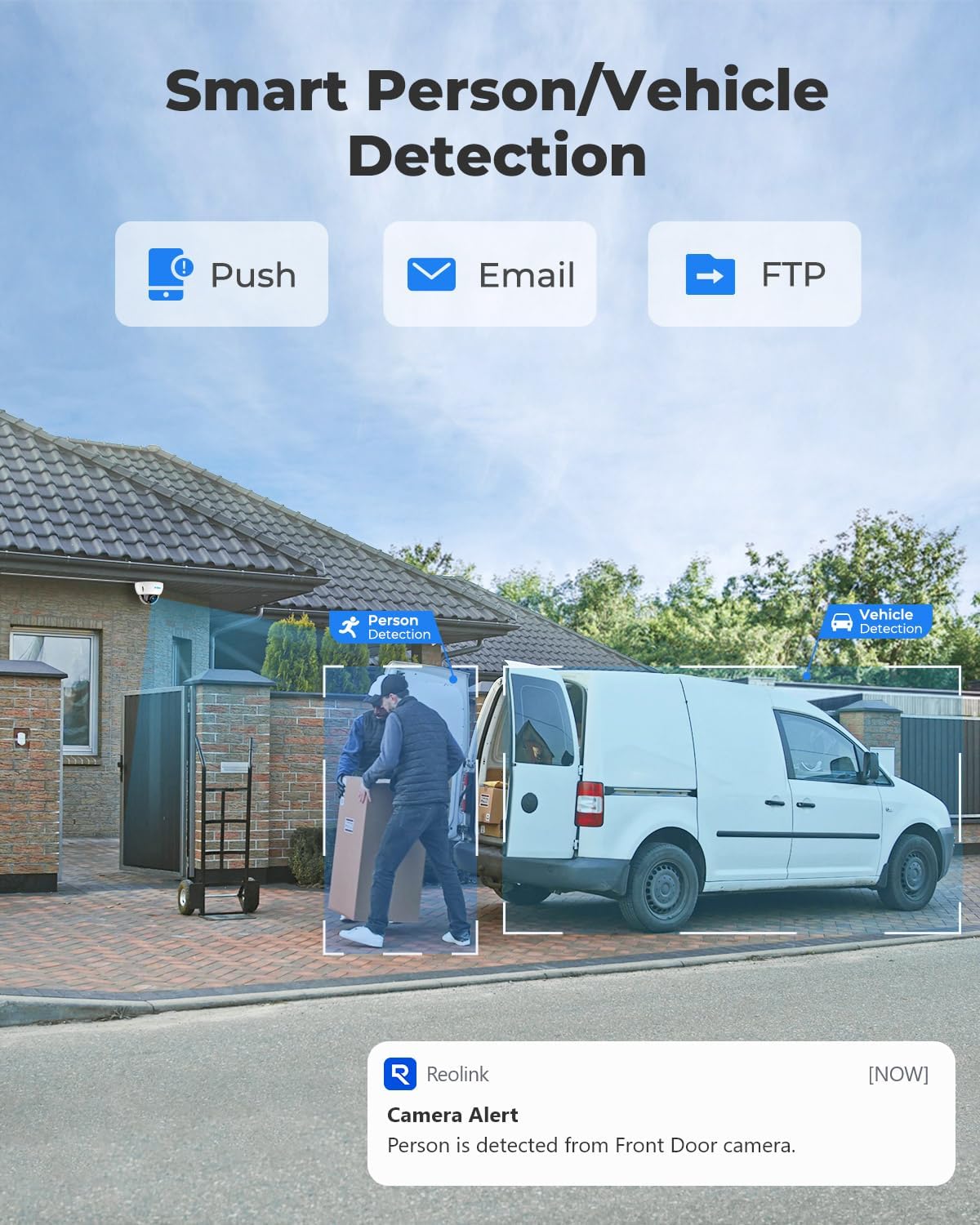
Reolink’s PoE (Power over Ethernet) NVR systems run a single Cat5e or Cat6 cable from each camera to the NVR. That one cable carries both power and video data — no separate power adapter at the camera, no coaxial. The result is a cleaner, more modern install. IP cameras also tend to deliver higher resolution than analog HDC cameras at equivalent price points, and they’re more configurable.
PCMag’s 2025 review “The Best Home Security Cameras” consistently recognizes Reolink for strong value-to-spec ratios in the PoE NVR category. The NVR includes a built-in hard drive bay, local storage is standard, and remote viewing is available through the Reolink app at no extra charge.
The ecosystem lock-in caveat bears repeating: Reolink NVRs are optimized for Reolink cameras. ONVIF compatibility (the industry standard for cross-brand IP camera interoperability) exists on paper, but owners report inconsistent results with non-Reolink cameras. If you’re building a pure Reolink ecosystem, this is a non-issue. If you’re mixing brands, budget for the troubleshooting time.
aosu
$349.99
In stock on Amazon
Check price on Amazonaosu Solar Base Station: The Wire-Free Local Option
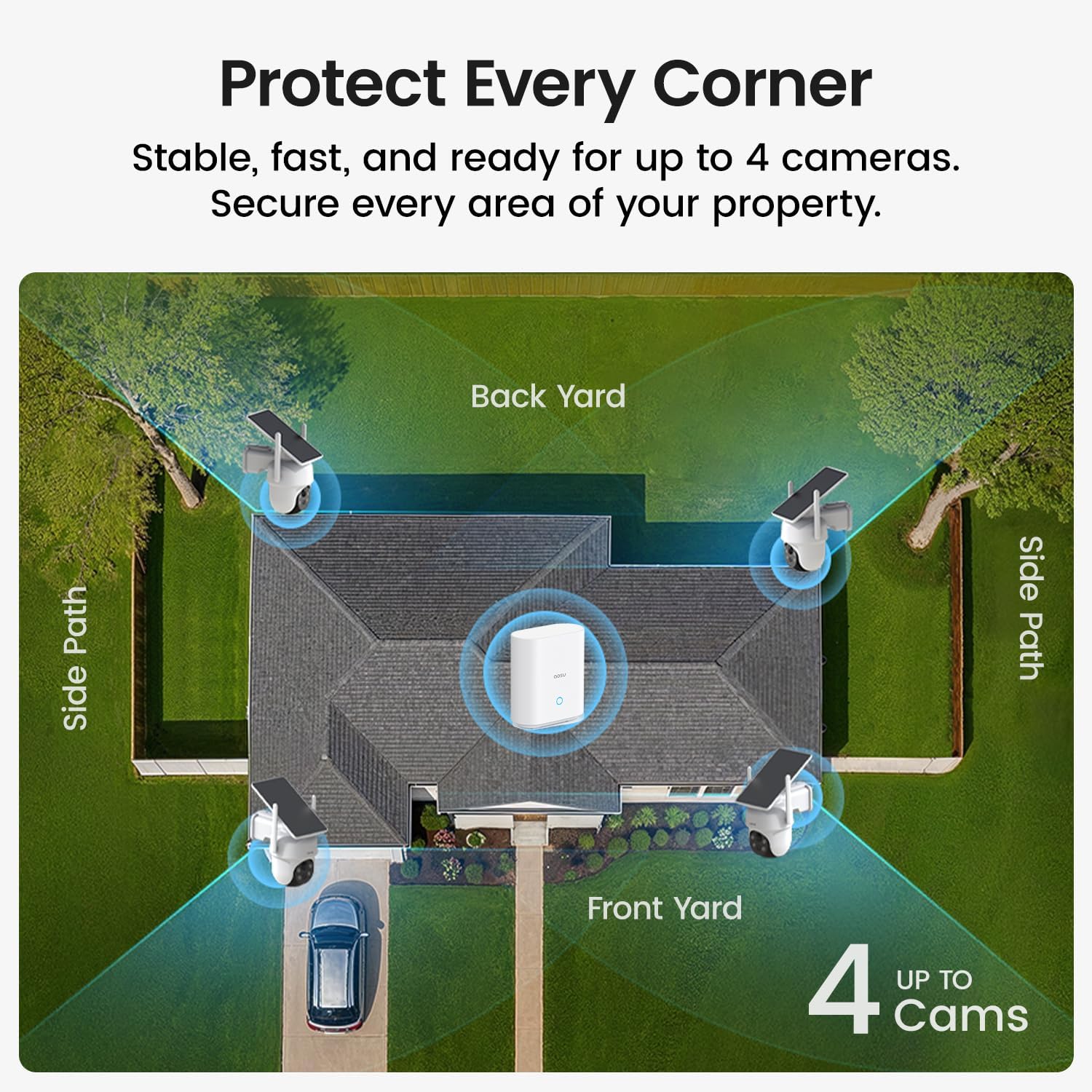
aosu’s solar system breaks from both wired approaches entirely. Cameras run on rechargeable batteries kept topped up by integrated solar panels. They communicate wirelessly with a base station hub that handles local storage (via SD card or USB drive, depending on model) and your home network connection. No cable runs. No electrician. No drilling through exterior walls for cable entry.
Reviewers consistently report 15–30 minute installs as achievable in real conditions — not lab conditions. SafeWise’s 2025 coverage “Best Wireless Security Camera Systems” notes that aosu’s mobile app interface is notably more polished than many competitors in the solar and wireless camera tier, a meaningful differentiator for households that will be managing cameras day-to-day through a phone.
The honest tradeoffs: solar cameras are dependent on sunlight. In northern latitudes during winter, or during extended cloudy stretches, battery levels can drop meaningfully. aosu addresses this with battery buffers designed to sustain recording through multi-day overcast periods, but this is a real variable to account for — more on this in the FAQ section.
REOLINK
$389.98
In stock on Amazon
Check price on AmazonThe Warranty and Service Reality Check
This section matters more than most buyers realize until they need it.
ANNKE: Owners report functional warranty service, with replacement processes that — while not instant — generally resolve legitimate hardware failures. Customer service interactions in aggregated reviews skew positive relative to category competitors.
Reolink: Long-term owner reviews reflect a consistent support experience for all-Reolink setups. Issues arise most often when users attempt mixed-brand configurations and then seek Reolink support for compatibility problems — which is outside the scope of what Reolink warranties cover.
Blink Outdoor 4 XR (included for comparison): This is the most important warranty data point in this product set, and it directly affects the value calculation for anyone considering Blink as a subscription-free alternative. At least one documented 1-star review describes a technician-confirmed defective camera that Blink refused to replace under warranty. The reviewer provided third-party technical confirmation of the hardware fault; Blink’s response was denial of the replacement claim. For a device in the $30–$50 per-camera range, that outcome erases the value proposition entirely. Tom’s Guide’s 2025 article “Best Outdoor Security Cameras” and CNET’s 2025 piece “Best NVR Security Camera Systems” both identify warranty and post-sale support as increasingly important differentiators as camera hardware commoditizes — and this data point illustrates exactly why.
By the Numbers: 5-Year Total Cost of Ownership
| System Type | Upfront (4-cam kit) | Subscription (5 yr) | Storage Replacement | ~5-Year Total |
|---|---|---|---|---|
| ANNKE DVR (4-cam + 1TB HDD) | ~$180–$250 | $0 | ~$60 (HDD yr 4–5) | ~$240–$310 |
| Reolink PoE NVR (4-cam + 2TB HDD) | ~$250–$380 | $0 | ~$60 (HDD yr 4–5) | ~$310–$440 |
| aosu Solar Base Station (4-cam) | ~$300–$450 | $0 | Battery repl. ~$40–$80 | ~$340–$530 |
| Ring/Blink equivalent (4-cam) | ~$120–$200 | ~$500–$600 (Basic/Plus plan) | Minimal | ~$620–$800 |
Estimates based on manufacturer MSRPs and subscription plan pricing as of May 2026. HDD and battery replacement intervals are approximations based on published component lifecycles.
The subscription math is the whole story. All three local-storage systems pay for their premium over subscription-dependent alternatives within 18–30 months for most households.
Frequently Asked Questions
Can I access ANNKE or Reolink footage remotely without a cloud subscription? Yes — both systems support remote viewing through their respective mobile apps using your home internet connection as a relay. You’re accessing your own recorder remotely; no cloud storage subscription is required. CNET’s 2025 article “Best NVR Security Camera Systems” confirms this is standard for both platforms.
Do Reolink cameras work with other NVR brands, or only Reolink’s own NVR? Reolink cameras support the ONVIF protocol, which theoretically enables cross-brand compatibility. In practice, long-term owners consistently report that full feature sets — motion zones, two-way audio, smart detection — only work reliably within an all-Reolink ecosystem. Treat Reolink as a closed ecosystem for planning purposes; compatibility with third-party NVR brands is a best-effort outcome, not a guarantee.
How much hard drive storage do I actually need for four to eight cameras? A general planning rule: at 1080p continuous recording, a 1TB drive handles approximately four cameras for about 7–10 days before overwriting begins. At 4K resolution, storage demand roughly quadruples. For a 4-camera 1080p system with 14-day retention, plan for 2TB minimum. For eight cameras at 4K, a 4–8TB surveillance-grade drive is a realistic starting point. Most DVR and NVR systems use motion-triggered recording by default, which extends storage duration significantly.
What happens to my footage if my internet goes down? Nothing bad — this is one of the core advantages of local-storage systems. ANNKE and Reolink NVRs continue recording to their hard drives regardless of internet connectivity. You lose remote viewing capability during an outage, but your footage is safe. aosu’s base station similarly stores footage locally; internet connectivity affects remote access, not local recording.
Do solar cameras keep recording on cloudy days or in winter? aosu’s solar cameras include internal battery packs designed to sustain operation through multi-day overcast conditions. However, extended low-light winters — particularly above the 45th parallel — can stress battery levels if the solar panel receives minimal direct sun for weeks at a time. aosu’s published specifications indicate battery reserves sufficient for approximately 3–5 overcast days depending on activity volume. For high-latitude or heavily shaded installations, the company recommends positioning panels for maximum southern exposure and may suggest supplemental USB charging capability on applicable models. This is a real planning variable, not a dealbreaker.
How does warranty and replacement support compare across these systems? ANNKE and Reolink both carry standard 1–2 year manufacturer warranties with documented replacement processes. aosu warranties cover hardware defects and are administered through the brand directly. The cautionary benchmark is Blink: as noted above, at least one buyer with a technician-confirmed defective unit was denied replacement under warranty — a documented failure of the warranty system that should factor into any subscription-free comparison. For any system, registering your product immediately after purchase and retaining proof of purchase are the two steps most owners skip and later regret.
The Decision Rule
If you’re choosing between these three systems right now, here’s the clean framework:
Choose Reolink PoE NVR if you’re running cable and want the best long-term image quality with zero ecosystem ambiguity. Commit to the Reolink ecosystem, enjoy the performance, and don’t mix brands.
Choose ANNKE DVR if you’re a subscription refugee who wants proven night vision performance and can handle a wired install. The IR performance reviews are consistent across thousands of buyers, the five-year cost math is compelling, and you’re building something that doesn’t depend on any company’s continued subscription business model.
Choose aosu Solar Base Station if you’re installing at a rental property, outbuilding, or any location where cable runs are impractical. The 15–30 minute install timeline is real. Budget for battery behavior in your climate, position panels thoughtfully, and you have a system that a non-technical tenant or property manager can live with.
What you’re not buying with any of these is a promise that Blink or Ring will keep their pricing stable, their servers running, or their warranty department cooperative. That’s the whole point.