September 20, 2026 • Kwame Osei-Bonsu • 11 min reading time • Prices verified June 18, 2026
Hardwired Motion Security Lights: LEPOWER, LUTEC 32W, and LUTEC 72W for Garages, Driveways, and Side Yards
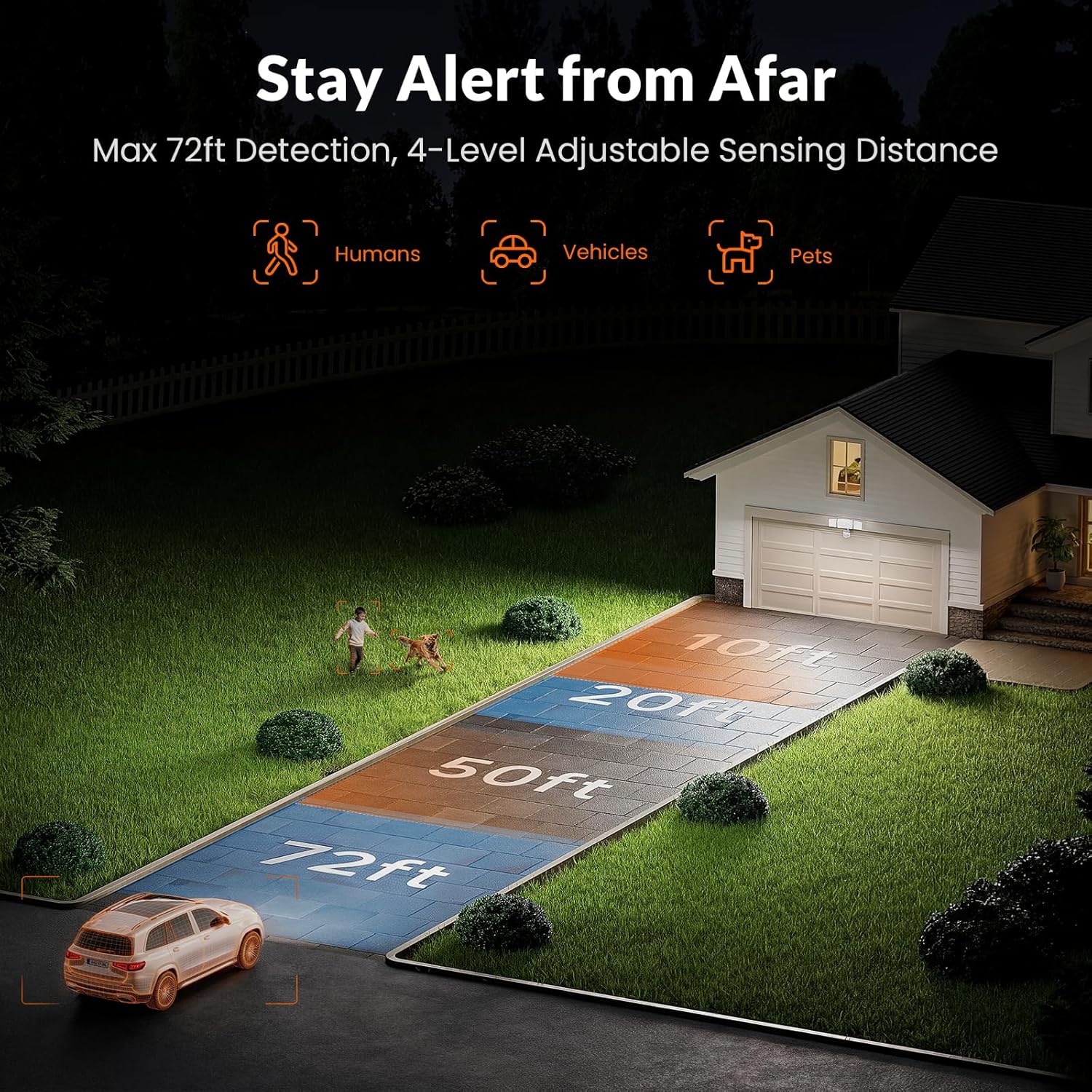
A hardwired motion security light is exactly what it sounds like: a flood light wired directly into your home’s electrical system — no batteries, no solar panel to fail on cloudy days — that switches on automatically when it detects movement within a set range. Unlike plug-in or solar models, hardwired lights run on your home’s 120V circuit, so they deliver consistent, high-output brightness every single night. For garages, driveways, and side yards, that consistency matters: a light that dims in winter or dies when the battery drains is worse than no light at all, because it trains you to stop trusting it. This article compares three well-reviewed hardwired options — the LEPOWER LED security light, the LUTEC 32W, and the LUTEC 72W — across the decisions that actually matter for a security-minded homeowner: lumen output, control flexibility, installation complexity, and long-term reliability. If you’re replacing an aging incandescent fixture or building out perimeter coverage for the first time, here’s the framework you need.
| EDITOR'S PICKLUTEC 72W 7500LM LED Security L… | Mid-tierLEPOWER LED Security Lights Mot… | Budget pickLUTEC 32W 3500 Lumen LED Securi… | |
|---|---|---|---|
| Brightness | 7500LM | 4200LM | 3500LM |
| Wattage | 72W | 38W | 32W |
| Color Temp | 5000K Daylight | 5500K | 5000K Daylight |
| Dusk to Dawn | ✓ | — | ✓ |
| Price | $39.99 | $35.98 | $31.99 |
| See on Amazon → | See on Amazon → | See on Amazon → |
Why Hardwired Still Beats Solar and Battery for Perimeter Security
The security community’s ongoing push toward wireless everything has genuine advantages for cameras and sensors — but for flood lights, hardwired wins on almost every practical dimension.
Consistency is the core argument. Solar-powered security lights are rated for a set lumen output, but real-world output drops when the panel is dirty, shaded by a tree, or charging through a week of overcast days. Battery-powered lights solve the shade problem but introduce a new failure mode: dead batteries discovered the morning after an incident. Hardwired lights, by contrast, perform identically in February as they do in July. Safe Wise, in their outdoor security lighting coverage published at safewise.com, recommends hardwired flood lights for primary perimeter zones where reliability is non-negotiable.
Lumen output is categorically higher. The products in this comparison range from roughly 3,200 to 6,000+ lumens — output levels that are simply not achievable at any reasonable price from battery-powered hardware. CNET’s outdoor motion-sensor light coverage, published at cnet.com, sets 3,000 lumens as the practical floor for driveway-grade illumination. A standard two-car driveway requires approximately 4,000–6,000 lumens for confident, security-grade coverage at full width.
Total cost of ownership favors hardwired. There are no replacement bulbs (all three units use integrated LEDs rated for 50,000+ hours), no batteries, and no subscription. You pay once for the fixture, once for installation, and then the only ongoing cost is a marginal addition to your electricity bill — typically less than $10 per year per fixture at average U.S. kWh rates for a light that runs two to four hours nightly.
The Three Units Compared
LEPOWER LED Security Light — The Value Benchmark
LUTEC
$31.99
In stock on Amazon
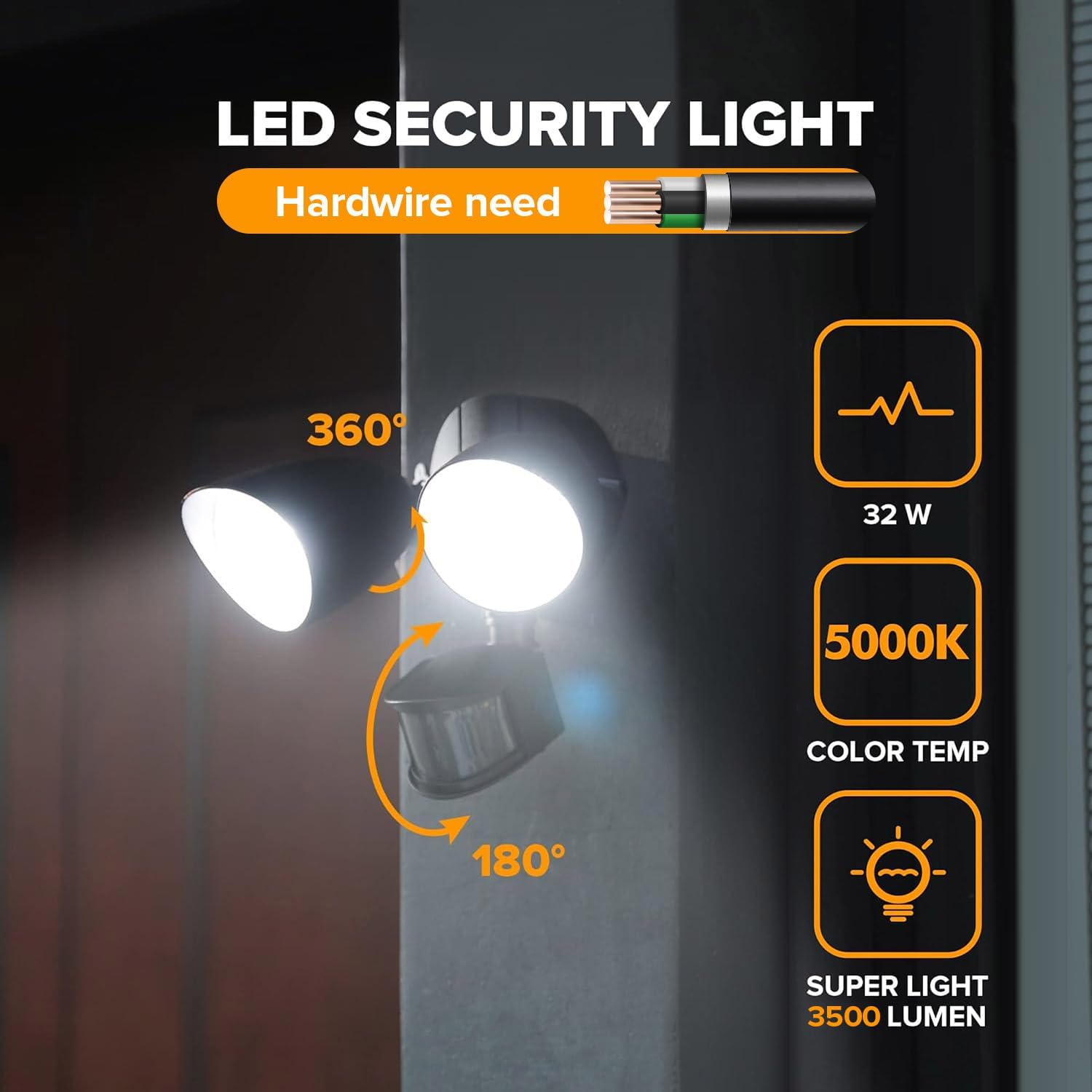
Check price on AmazonThe LEPOWER sits at the entry point of this comparison but punches meaningfully above its price class. Published manufacturer specifications put it at approximately 3,500 lumens from an integrated LED array, with a PIR (passive infrared) motion sensor rated to cover a 180-degree field at up to 70 feet. The fixture carries an IP65 rating, meaning it is tested to resist jets of water from any direction — sufficient for rain and snow exposure across most North American climates.
What distinguishes the LEPOWER in long-run buyer experience is a detail that rarely appears in spec comparisons: an included installation multi-tool. Owners consistently note it reduces the number of trips up and down the ladder during a solo install. More tellingly, the repurchase pattern associated with this fixture is a stronger real-world signal than any individual review. Buyers who install one LEPOWER unit frequently report returning within days to order two or three more — a deliberate decision made after living with the product rather than a reaction to a first impression.
The honest limitation: 3,500 lumens is adequate for a single-car garage apron or a narrower side-yard path, but sits toward the lower edge of coverage for a wide two-car driveway, particularly if the fixture is mounted below the recommended 9–10 feet.
LUTEC
$31.99
In stock on Amazon
Check price on AmazonLUTEC 32W — The Controllability Pick
LEPOWER
$35.98
In stock on Amazon
Check price on AmazonThe LUTEC 32W steps up in control flexibility. Published spec sheets show a fixture with adjustable sensitivity (low, medium, high), adjustable time delay — controlling how long the light stays on after motion stops, from approximately 10 seconds to 7 minutes — and an adjustable lux threshold so the light will not trigger during daylight hours. Rated lumen output is approximately 3,200 lumens, marginally lower than the LEPOWER, which is worth noting when comparing the two on brightness alone.
The practical differentiator is the time-delay dial. Tom’s Guide, in their Best Motion Sensor Lights feature published at tomsguide.com, identifies adjustable dwell time as a top-tier feature that separates functional security lights from frustrating ones. A light that stays on for a predictable, defined window rather than cycling off the moment you stop moving is meaningfully safer on stairs and more comfortable for guests arriving after dark.
The installation caveat with the LUTEC 32W is real and worth surfacing before purchase. Multiple owners replacing older dome-style incandescent fixtures — common in homes built between the 1970s and 1990s — report that the old junction box is deep enough to house the original fixture’s wire nuts and hardware, but the LUTEC 32W’s backplate sits nearly flush against the wall. The practical fix is a junction box extender ring (widely available at hardware stores, typically under $5), but this is a genuine pre-purchase warning: budget for it and add roughly 20 minutes to your install time if you are working on an older home.
LEPOWER
$35.98
In stock on Amazon
Check price on AmazonLUTEC 72W — The Perimeter Architecture Pick
LUTEC
$39.99
In stock on Amazon
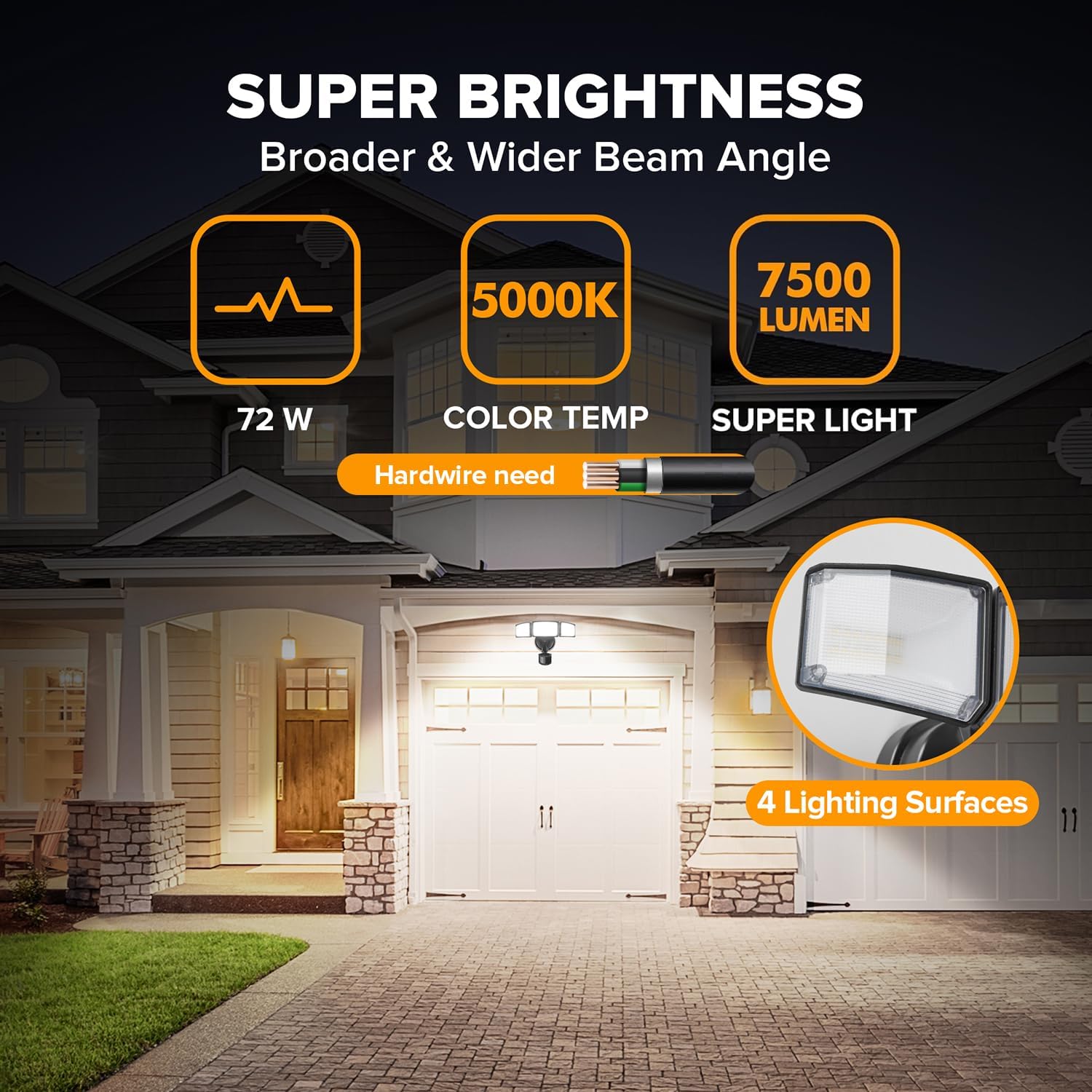
Check price on AmazonThe LUTEC 72W is a categorically different fixture from its 32W sibling. At 72 watts and a manufacturer-rated 6,000+ lumens delivered across dual independently adjustable heads, it is built for situations where coverage width and raw brightness are the primary requirements: wide driveways, parking areas, barn approaches, and commercial-adjacent residential perimeters.
The specification that distinguishes it most sharply for security-architecture use is its dual-mode capability: a 50%-always-on dusk-to-dawn baseline combined with 100% brightness on motion activation. This is not a minor feature. Multiple long-run reviewers describe setting up the LUTEC 72W in this mode as a deliberate perimeter security decision rather than an incidental default. The always-on dim baseline eliminates the complete darkness that makes pure motion-only lights gameable — a determined intruder who knows the sensor location can sometimes move slowly enough to avoid triggering it. The dim baseline also provides navigational light for residents without burning full power all night.
Consumer Reports, in their Outdoor Security Lighting Buying Guide published at consumerreports.org, notes that dual-mode fixtures combining an ambient baseline with a motion-triggered brightness burst represent current best practice for perimeter flood lighting, balancing energy efficiency with deterrence effectiveness.
The same repurchase pattern seen with the LEPOWER appears strongly in LUTEC 72W owner accounts as well. Buyers routinely describe ordering a second unit shortly after installing the first — often to cover the zone the first unit’s motion sensor could not reach from the initial mounting position. If your driveway or parking area is your primary coverage goal, budgeting for two units from the outset is the more realistic plan.
LUTEC
$39.99
In stock on Amazon
Check price on AmazonBy the Numbers
| Feature | LEPOWER | LUTEC 32W | LUTEC 72W |
|---|---|---|---|
| Rated lumens | ~3,500 | ~3,200 | ~6,000+ |
| Wattage | ~35W | 32W | 72W |
| IP rating | IP65 | IP65 | IP65 |
| Dusk-to-dawn mode | No | No | Yes (50% always-on) |
| Adjustable dwell time | Limited | Yes (10 sec–7 min) | Yes |
| Dual adjustable heads | Yes | Yes | Yes |
| Best fit | Garage / side yard | Walkways / entries | Driveways / perimeter |
Installation Reality Check: What to Know Before You Wire
All three units are designed for direct 120V hardwired installation to a standard outdoor junction box. None require a neutral wire beyond the standard two-conductor-with-ground outdoor wiring that has been common since the 1970s. In most municipalities, replacing a like-for-like fixture at the same location with the same wiring is considered a homeowner-permissible task — but thresholds vary by jurisdiction.
If you are adding a new circuit, extending wiring from a panel, or your home has aluminum wiring (common in homes built between 1965 and 1973), licensed electrical work is the correct and safe approach. When in doubt, a five-minute call to your local building department removes ambiguity.
For straightforward replacements — turning off the breaker, capping the old fixture, connecting the new fixture’s leads with wire nuts, and mounting to the existing box — most mechanically confident homeowners rate these installs at 30–60 minutes. The LUTEC 32W deep-box issue adds time but not complexity. The LEPOWER’s included multi-tool reduces unnecessary ladder trips.
If you are running conduit to a new location on an exterior wall, budget 2–4 hours and consider whether a licensed electrician is worth the cost for peace of mind, particularly if the new run requires fishing wire through an interior wall cavity.
Decision Framework: If X, Then Y
If your primary concern is value and you are covering a garage apron or narrow side yard: The LEPOWER is the correct starting point. The repurchase pattern in owner accounts confirms buyers find it reliable enough to commit additional money and ladder time to expand coverage — that signal matters more at this price tier than any single rating.
If you are installing on a motion-lit stairway, entry path, or any zone where a light cycling off unpredictably creates a safety or comfort problem: The LUTEC 32W’s adjustable dwell-time dial is not a nice-to-have for your use case — it is the feature that makes the difference between a functional light and a frustrating one. Accept the possible need for a junction box extender if you are working on an older home.
If you are covering a two-car driveway, a parking pad, or any exterior zone where you want a persistent dim presence plus a full-brightness deterrence burst on motion: The LUTEC 72W is the purpose-built answer. The 50%-always-on mode is an architecture decision that multiple long-run owners confirm works as intended. Budget for two units from the start; the repurchase pattern suggests most buyers end up there anyway.
If your home was built before 1990 and you have not assessed your outdoor junction boxes: Pull the old fixture before you order. A deep box is a minor inconvenience with a $5 fix; discovering it on the day of your planned install is an avoidable frustration.
Frequently Asked Questions
Can I adjust how long the light stays on after motion stops? Yes, on the LUTEC 32W and LUTEC 72W — both include a dial or switch controlling dwell time. The LUTEC 32W’s range runs from approximately 10 seconds to 7 minutes. The LEPOWER offers more limited adjustment. If predictable dwell time matters for your installation — especially on stairs or walkways — prioritize the LUTEC 32W or 72W.
Is IP65 actually waterproof enough for rain and snow? IP65 is the standard rating for outdoor fixtures. Per the IEC 60529 classification system, IP65 indicates protection against low-pressure water jets from any direction, covering rain, snow, and hose splash. It does not indicate submersion protection, but for any standard exterior wall-mount application, IP65 is the correct and sufficient rating. All three units in this comparison carry it.
How do I replace an old incandescent fixture if the junction box is too deep? Turn off the circuit breaker and verify power is off with a non-contact voltage tester before touching any wiring. Pull the old fixture and assess the box depth. If the new fixture’s backplate sits flush against the wall and there is no clearance for wire nuts inside the box, the fix is a metal or plastic junction box extension ring — a few dollars at any hardware store — which brings the mounting surface out to the correct depth. This is a documented issue specifically noted by owners replacing older dome-style incandescent fixtures with the LUTEC 32W.
What is the difference between dusk-to-dawn mode and motion-only mode? Motion-only mode means the light is off until the PIR sensor detects movement, then activates at full brightness for the dwell period before shutting off again. Dusk-to-dawn mode, available on the LUTEC 72W at 50% output, keeps the light on at reduced brightness from sunset to sunrise and surges to 100% when motion is detected. For perimeter security, the dual mode has a meaningful advantage: it eliminates the complete darkness that pure motion-only lights create between triggers, providing ambient visibility while still delivering a deterrence burst on activation.
Is 3,500 lumens enough to cover a two-car driveway? 3,500 lumens is workable for a single-car garage or a narrower driveway when mounted at 9–10 feet. For a standard two-car driveway running 16–20 feet wide, coverage guidance from CNET’s outdoor motion-sensor light reporting and Safe Wise’s outdoor lighting recommendations both point toward 4,000–6,000 lumens for confident security-grade coverage at that width. The LUTEC 72W at 6,000+ lumens is the correct single-fixture choice for full two-car driveway coverage; two LEPOWER or LUTEC 32W units positioned at opposing angles is a workable alternative approach.
Do I need an electrician to install a hardwired motion security light? For a like-for-like fixture replacement at the same location with an existing outdoor junction box and standard 120V wiring, most jurisdictions allow homeowner self-installation without a permit. If you are adding a new circuit run, extending wiring from a panel, or your home has aluminum wiring, licensed electrical work is the correct and safe approach. When in doubt, contact your local building department — the question takes five minutes and removes all ambiguity.