June 3, 2026 • Kwame Osei-Bonsu • 10 min reading time • Prices verified June 18, 2026
Hardwired Motion Security Lights vs. Solar Three-Head Fixtures: An Honest Brightness and Reliability Comparison
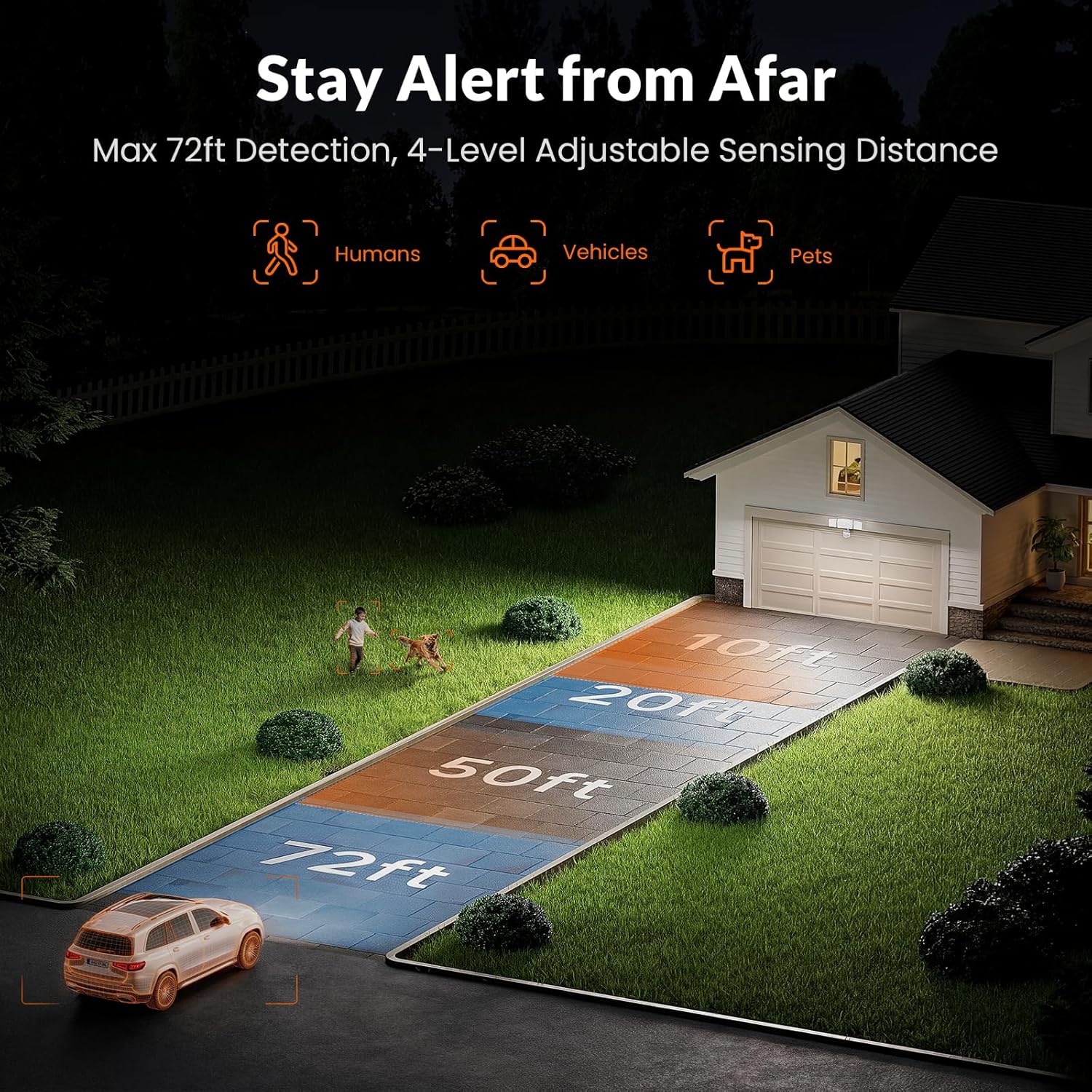
Motion-activated security lights are exactly what they sound like: outdoor lights that stay off until a sensor detects movement nearby, then switch on to flood the area with light. The idea is simple — a sudden burst of bright light startles would-be intruders, removes the cover of darkness, and signals to neighbors or cameras that something is happening. The two dominant options on the market right now are hardwired fixtures (which connect permanently to your home’s electrical system, the same way a porch light does) and solar-powered fixtures (which charge a built-in battery during the day using a small panel, requiring no wiring at all). Both can work well. But they don’t work equally well everywhere, and the difference matters more than most product listings will tell you. This article breaks down brightness, reliability, installation reality, and long-term cost so you can make a decision with clear eyes.
Why Brightness Is the Variable That Actually Determines Deterrence
Before comparing specific fixtures, it’s worth anchoring to what “bright enough” actually means in a security context.
Security.org’s Home Security Lighting Guide puts the deterrence threshold at roughly 700 lumens for a focused motion light covering a driveway or walkway — enough to illuminate a person’s face clearly at 20–30 feet. For a wider perimeter, like the side of a house or a backyard with multiple entry points, reviewers and installers consistently reference 2,000 lumens or more as the functional minimum. Below that, you get light that startles but doesn’t illuminate, which is a partial solution at best.
Here’s where the hardwired-versus-solar divide becomes concrete:
Published lumen specs at a glance:
- LEPOWER hardwired motion flood: 2,500–3,500 lumens
- LUTEC 32W hardwired flood: approximately 3,200 lumens
- LUTEC 72W hardwired flood: approximately 6,000–7,200 lumens (dual-mode)
- Typical solar three-head motion fixture: 800–1,500 lumens (manufacturer-rated, best-case conditions)
That gap is not marketing noise. It reflects a fundamental physics constraint: a solar fixture’s output ceiling is determined by how much charge its battery can store and discharge, which is limited by panel size, sun hours, and battery capacity. Hardwired fixtures pull from the grid on demand, so their ceiling is essentially wherever the wattage and LED driver can take them.
SafeWise’s How to Choose Outdoor Security Lighting guide notes this explicitly, flagging that solar fixtures rated in “equivalent lumens” or “LED lumens” sometimes use optimistic measurement conditions — calm temperatures, full sun, fully charged battery — that don’t reflect performance at 2 a.m. after three overcast days.
Comparing the Three Tiers: Budget Solar, Mid-Range Hardwired, and Premium Hardwired
Budget Option: Solar Three-Head Motion Fixtures
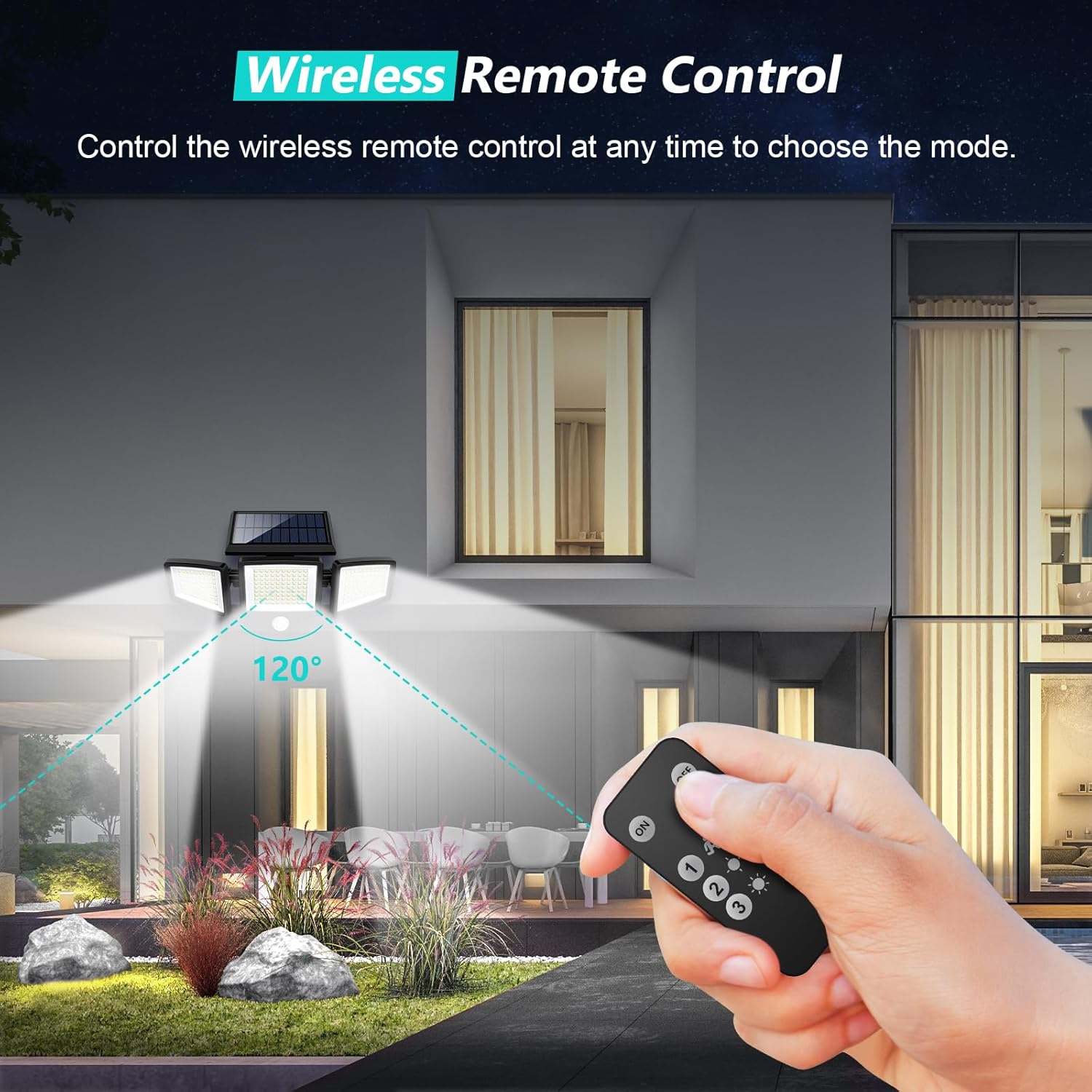
Solar three-head fixtures occupy the entry tier because they require no wiring — you mount them on any sun-exposed surface, angle the heads, and they work. The installation argument is real and meaningful for locations with no existing wiring, such as a detached garage wall, a back fence line, or a side path.
The honest data point every buyer needs before purchasing: owner reviews of solar three-head fixtures consistently describe them as adequate but not bright. Multiple owners of fixtures in this category note that a single unit does not cover a full driveway at useful security brightness, and several report purchasing a second set to achieve adequate coverage. This is not a defect — it is a category characteristic driven by battery budget. On a fully charged day, a well-designed fixture delivers rated output for the first several triggers. After two or three consecutive cloudy days, that budget depletes, output drops, and some fixtures switch to a dim standby mode or stop triggering reliably.
CNET’s Best Motion Sensor Lights coverage consistently places solar fixtures in a “supplemental” rather than “primary perimeter” category for this reason, recommending them for low-traffic locations or as additions to an existing hardwired setup rather than standalone coverage for critical entry points.
Placement flexibility: High — any sun-exposed surface with a mounting point. Winter reliability in northern climates: Reduced. Most solar fixtures assume 4–6 peak sun hours per day to maintain full charge. In northern U.S. latitudes above 40°N, December and January average 1.5–3 peak sun hours, which means the battery enters each night partially depleted. Long-term cost: Near-zero after purchase.
Tuffenough
$25.99
In stock on Amazon
Check price on AmazonMid-Range Option: Hardwired Single or Dual-Head Floodlights
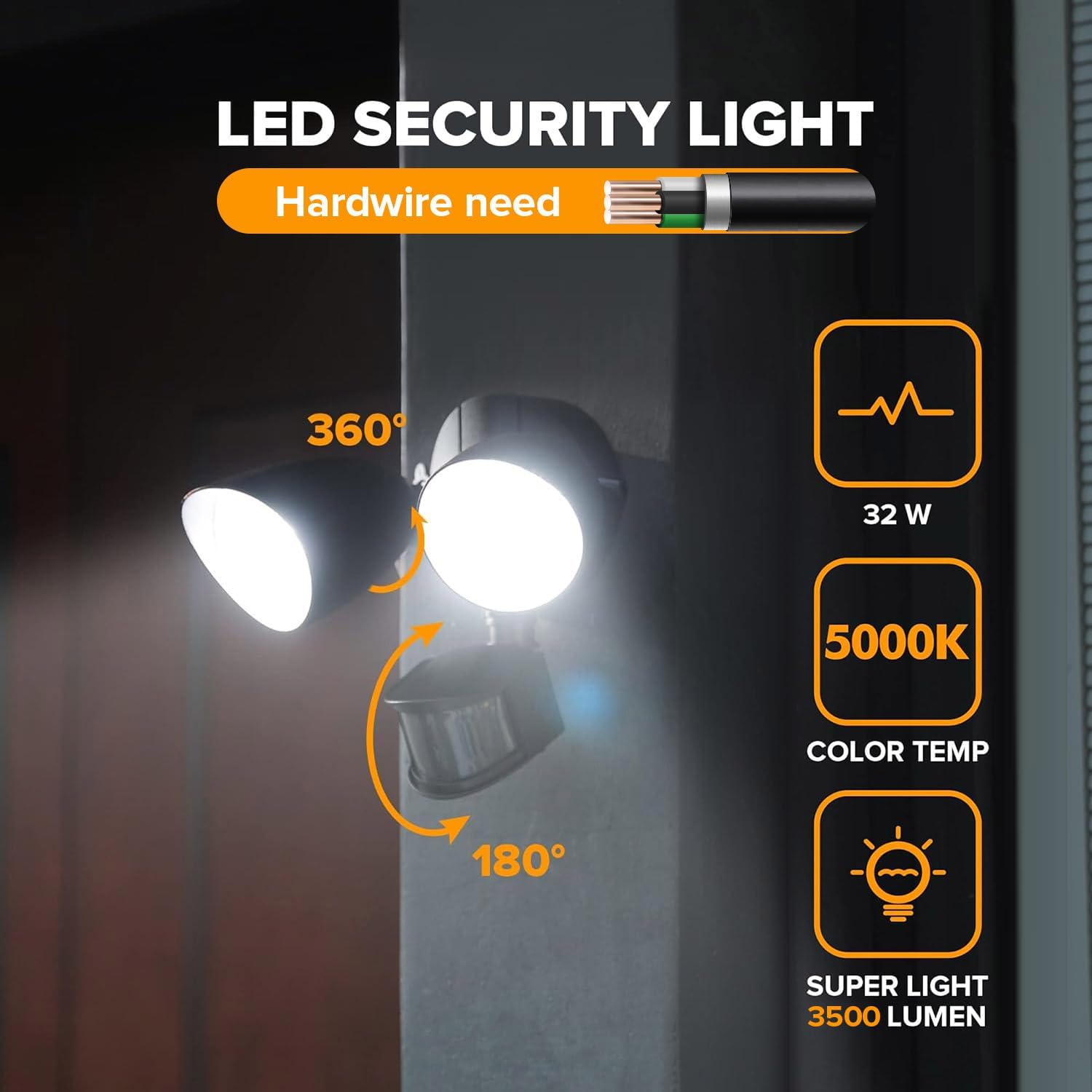
The LEPOWER hardwired motion flood and the LUTEC 32W represent the mid-range hardwired category: fixtures that deliver 2,500–3,200 lumens on motion, install into an existing exterior junction box, and cost under $60. Tom’s Guide’s Best Outdoor Security Lights coverage places fixtures in this lumen range as the practical minimum for driveway and garage coverage, noting that they produce enough light for most residential cameras to generate a usable image at 20–30 feet.
Installation for a direct replacement is a legitimate DIY project. The typical workflow: turn off the circuit breaker, verify the circuit is dead with a non-contact voltage tester, remove the old fixture, match wire colors (black to black, white to white, bare copper to ground), secure the fixture to the existing box, and restore power. CNET and Tom’s Guide reviewers describe this as a 45-minute job for anyone with basic DIY comfort — specifically, someone who has swapped an outlet or changed a ceiling fan.
Where complexity increases is when adding a new fixture in a location with no existing wiring. That requires running conduit or fishing wire through walls to reach a circuit, which crosses into licensed-electrician territory in most municipalities and should be permitted. That distinction — replace versus new run — is the most important installation variable in this category.
Peak brightness: 2,500–3,200 lumens. Reliability: Consistent year-round, grid-powered. Installation complexity: Moderate for replacements, high for new locations.
LUTEC
$31.99
In stock on Amazon
Check price on AmazonPremium Option: LUTEC 72W Hybrid-Mode Hardwired Flood
The LUTEC 72W stands apart from both categories above for one specific feature: a hybrid always-on/motion-burst mode that no solar fixture in this price range can match on a reliable basis.
In hybrid mode, the fixture maintains output at roughly 50% brightness continuously from dusk to dawn — functioning as a standard dusk-to-dawn perimeter light — then ramps to 100% output when motion is detected. At 6,000–7,200 lumens total output, the 50% floor is brighter than most solar three-head fixtures at full rated output. PCMag’s coverage of smart outdoor security lights in their Best Smart Outdoor Security Lights guide consistently flags always-on or hybrid modes as a meaningful differentiator for perimeter security specifically, as opposed to entryway lighting where motion-only is usually sufficient. The hybrid mode solves a genuine problem: pure motion-only lights leave a property dark between triggers, which can create blind spots for cameras and communicate a “nobody watching” signal during quiet periods.
The three independently adjustable heads on the LUTEC 72W allow coverage of a wide driveway apron, a side gate, and a garage face simultaneously from a single mounting point — one wire run, one junction box, three coverage zones. Owners who have installed multiple units around a full property perimeter describe this as the primary argument for the fixture over multiple single-head units.
Peak brightness: 6,000–7,200 lumens. Hybrid always-on mode: Available; 50% continuous output floor. Installation complexity: Same as mid-range replacement; electrician required for new wire runs. Long-term operating cost: Minimal electric draw, estimated $3–6 per year at average U.S. residential rates.
LEPOWER
$35.98
In stock on Amazon
Check price on AmazonSide-by-Side Decision Frame
| Factor | Solar Three-Head | Hardwired Mid-Range | Hardwired Premium (LUTEC 72W) |
|---|---|---|---|
| Peak brightness | 800–1,500 lumens | 2,500–3,200 lumens | 6,000–7,200 lumens |
| Winter reliability | Degrades with reduced sun | Consistent | Consistent |
| Installation complexity | Low (mount and angle) | Moderate (replace existing) | Moderate (replace existing) |
| Placement flexibility | High — any sun-exposed surface | Limited by wiring | Limited by wiring |
| Hybrid always-on mode | Rare, battery-constrained | Not typical at this tier | Yes |
| Long-term operating cost | Near-zero | ~$2–4/year | ~$3–6/year |
Frequently Asked Questions
How bright do motion security lights actually need to be to deter intruders?
Security.org’s Home Security Lighting Guide cites 700 lumens as a minimum for a focused entry point and 2,000 or more lumens for broader perimeter coverage. The practical threshold is less about a specific number and more about whether the light fully illuminates a person’s face and clothing at the distance where your camera or a neighbor’s line of sight begins. If your camera is 25 feet from the detection zone, you need enough output to produce a usable image at that distance — typically 1,500 lumens minimum aimed at that zone, and more if the area is wide.
Can I install a hardwired motion light myself without an electrician?
Yes, if you are replacing an existing fixture in an existing junction box. Turn off the breaker, verify with a non-contact voltage tester that the circuit is dead, swap wires by matching colors, and remount. It is a legitimate DIY project. If you are running a new circuit or fishing wire through finished walls, that work requires a licensed electrician in most U.S. jurisdictions and should be permitted — not because it is physically difficult, but because unpermitted electrical work can affect homeowner’s insurance claims and resale inspections.
Do solar security lights work in winter or on consecutive cloudy days?
They work, but not at full rated output. Most solar fixtures are designed around 4–6 peak sun hours per day. In northern latitudes during winter, you may see 1.5–3 peak hours, which means the battery enters each night partially depleted. After two or three cloudy days in a row, brightness and trigger reliability will degrade. In high-sun climates, this is manageable. In the Pacific Northwest, upper Midwest, or New England, treat solar fixtures as a supplement rather than a primary security perimeter light for critical locations.
What is the difference between dusk-to-dawn mode and motion-only mode?
Motion-only mode keeps the fixture dark until the sensor detects movement, then switches on for a set duration before returning to off. Dusk-to-dawn mode keeps the light on continuously from sunset to sunrise. Many fixtures, including the LUTEC 72W, offer a hybrid: dimmed continuous output that ramps to full brightness when motion is detected. For security purposes, the hybrid mode offers ambient deterrence plus a clear motion alert — at the cost of higher power draw, which is relevant only for solar fixtures, not hardwired ones.
How far away can these lights detect motion?
Most hardwired and solar motion fixtures use passive infrared (PIR) sensors rated for 20–70 feet of detection range in a roughly 180-degree arc. Real-world performance is typically closer to 30–40 feet for reliable triggering. Tom’s Guide’s Best Outdoor Security Lights coverage consistently notes that mounting height — 8–10 feet is the sweet spot for most residential PIR fixtures — affects both range and false-trigger rate. PIR sensitivity also decreases in cold weather because the sensors work by detecting heat differential; a person moving through cold air produces a smaller signal than the same person moving through warm air.
Can I point the individual light heads in different directions to cover a wider area?
Yes — this is one of the primary arguments for three-head fixtures over single-head floodlights. Each head on a multi-head fixture is independently adjustable, typically on a ball joint with a locking collar. A three-head configuration can cover a wide driveway apron, a side gate, and a garage face simultaneously from a single mounting point. Owners installing the LUTEC 72W specifically cite this as a reason for choosing the fixture over multiple single-head units: one wire run, one mounting location, three coverage zones.
The Decision Rule
If you have an existing exterior junction box in the location you need covered, a hardwired fixture is the clear choice for any property where consistent, high-output lighting matters — rental units, large lots, perimeter coverage in northern climates, or anywhere you need a camera to produce a usable image at night. The LUTEC 72W’s hybrid mode is worth the premium if you want ambient perimeter presence plus motion burst from a single unit.
If you need coverage in a location with no existing wiring — a detached garage, a back fence line, a side path — and you are in a climate that delivers reasonable sun year-round, a solar three-head fixture is a legitimate and low-installation-cost option. Go in knowing the brightness ceiling is real, buy more units than you think you need if coverage matters, and plan on supplementing with hardwired fixtures at any location where you genuinely cannot afford a dark window.
The one outcome to avoid: buying a single budget solar fixture for a critical entry point, assuming it will perform like a hardwired flood, and discovering the gap when you need the footage.