September 4, 2026 • Kwame Osei-Bonsu • 12 min reading time • Prices verified June 18, 2026
Smart Locks for Airbnb and Rental Properties: Schlage, eufy, ULTRALOQ, and Veise Assessed by Actual Hosts
A smart lock is a door lock you can control with your phone, a keypad code, or an app — no physical key required. For rental property owners, that means you can give a guest a unique entry code before check-in and delete it the moment they check out, all without being anywhere near the property. If you’ve been managing a short-term rental — an Airbnb, a VRBO listing, or even a long-term furnished unit — you already know that key handoffs are one of the biggest operational headaches in the business. Smart locks are the direct solution. But the category has exploded, and not every lock built for a homeowner holds up on a door that gets opened 20 or 30 times a day by people who have never touched it before. This guide cuts through the noise by focusing on four locks that rental hosts are actually buying and reviewing in volume: the Schlage Encode, the eufy C30 and C210, the ULTRALOQ U-Bolt Pro, and the Veise VE06-H. We’ll surface what’s working, what’s failing, and exactly which scenarios each lock fits best.
| EDITOR'S PICKSchlage Encode Smart Wi-Fi Dead… | Mid-tiereufy Security Video Smart Lock… | Budget pickeufy Security Smart Lock C210 | |
|---|---|---|---|
| Fingerprint | — | ✓ | — |
| Camera | — | ✓ | — |
| Storage | — | 8 GB | — |
| Keypad | Touchscreen | — | Touchscreen |
| Power | — | — | 4 AA batteries |
| Price | $229.00 | $199.98 | $89.99 |
| See on Amazon → | See on Amazon → | See on Amazon → |
Why Rental Properties Break Smart Locks Faster Than Homes
Before comparing models, it’s worth naming the variables that separate a rental-grade install from a residential one.
Traffic volume is the first killer. A household door might get opened 6–10 times a day. A busy Airbnb in a tourist market can see 20–35 open/close cycles daily across guests, cleaners, and maintenance. Battery-powered locks — which is most of the consumer market — drain in proportion to motor actuations, not calendar time. A lock rated for 6 months in a typical home may last 6–8 weeks on a high-volume rental door.
User variability is the second. Your family learns how hard to pull the door, when to push before turning, how to handle a sticky latch. Guests don’t. They force the mechanism, try the code on a door that isn’t fully closed, or panic-call you when a battery drops mid-stay. Every lock’s motor and latch assembly absorbs this abuse differently.
Remote management depth is the third. A homeowner can walk to their front door. You can’t. That means you need remote lock/unlock, code management from an app, real-time access logs, and — ideally — direct integration with the platform (Airbnb, VRBO) generating your reservations.
With those variables named, here’s how the four contenders stack up.
Schlage Encode and Encode Plus: The Airbnb Integration Lock
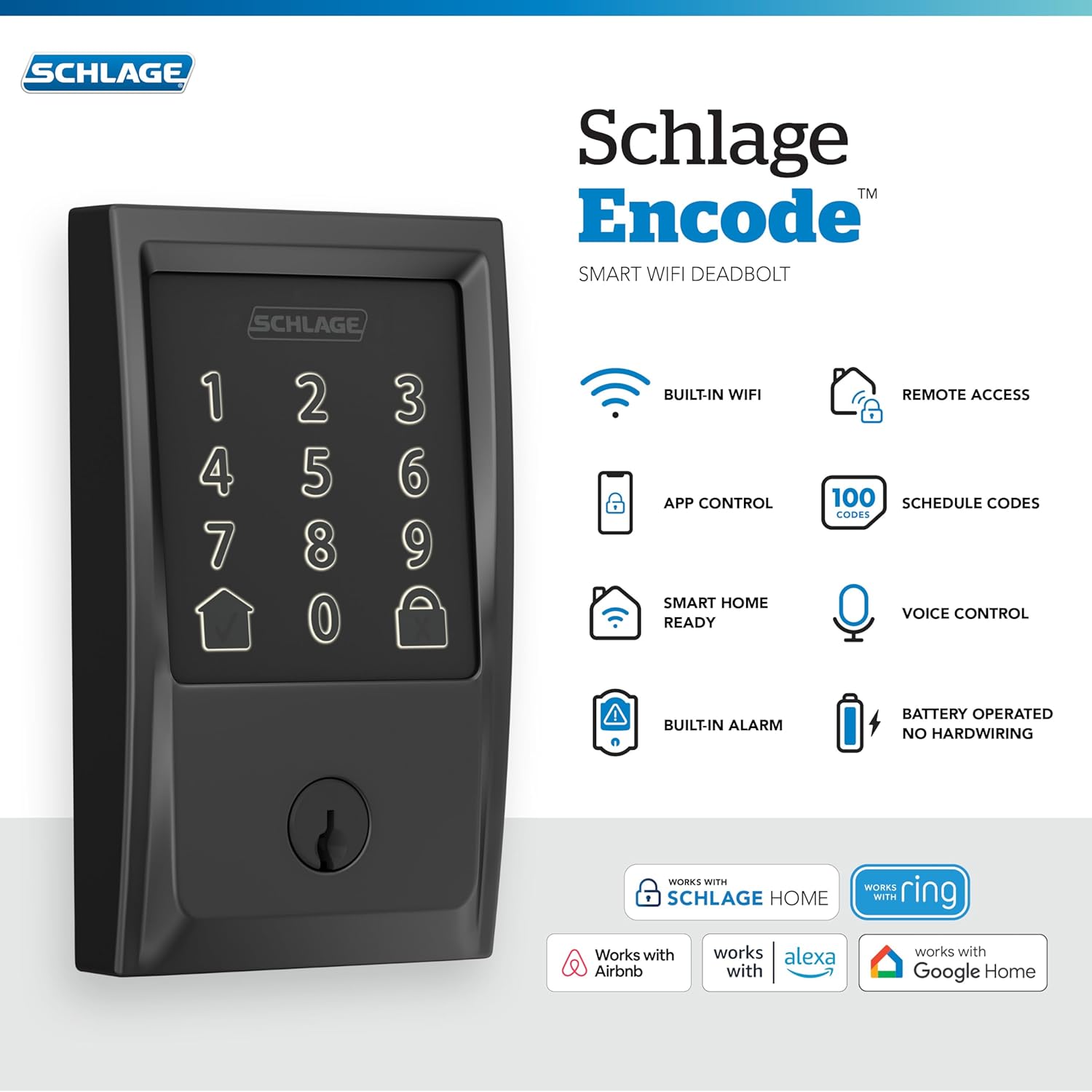
The Schlage Encode is the lock hosts mention most often in long-form rental reviews, and the reason is specific: it integrates directly with the Airbnb platform to create and expire guest access codes automatically, synced to reservation windows. Across aggregated reviews on CNET’s smart lock roundup and SafeWise’s rental-focused guide, hosts consistently call this the feature that eliminates the most manual labor in their operation. One host described the Encode as “the best smart lock I’ve tried” precisely because the Airbnb integration meant they never had to remember to delete a code or worry about a former guest re-entering.
The Encode Plus — the upgraded version with Apple HomeKit and Thread support — adds to this by making the lock addressable through Apple’s Home ecosystem without a proprietary bridge. Thread is a low-power mesh networking protocol that keeps the lock responsive even when your router is rebooting or congested. For hosts already running HomeKit, this is a meaningful addition.
Where the Encode earns criticism: PCMag’s 2025 buying guide and Security Baron’s Encode Plus review both note that the lock is WiFi-direct, meaning it connects to your router without a hub. That’s convenient for installation, but it also means battery drain is higher than Bluetooth-only locks because the WiFi radio runs continuously. On rental-volume doors, hosts report needing battery swaps every 2–3 months rather than the manufacturer-rated period.
More seriously: there is a documented latch failure case in the Encode Plus review ecosystem that should not be glossed over. A 1-star review — with photographic documentation — describes a latch mechanism failing within the warranty period, combined with a frustrating Schlage customer support experience that did not resolve the issue quickly. Security Baron’s editorial notes confirm the support complaint pattern appears across multiple verified buyers. This isn’t a majority experience, but on a rental property where a lock failure means a locked-out guest at 11 PM, “rare” failure has outsized consequences. Our take: if you run Schlage Encode on a rental, keep a backup physical key in a lockbox on-site. Full stop.
By the numbers — Schlage Encode rental-relevant specs:
| Feature | Encode | Encode Plus |
|---|---|---|
| WiFi built-in | Yes (2.4 GHz) | Yes (2.4 GHz) |
| Hub required for remote access | No | No |
| HomeKit / Thread | No | Yes |
| Airbnb direct integration | Yes | Yes |
| ANSI/BHMA grade | Grade 1 | Grade 1 |
Grade 1 is the highest residential security rating from the American National Standards Institute — relevant when insurers ask about your property’s security hardware.
eufy C30 and C210: Strong Value, Battery Reality Check
The eufy smart lock line — specifically the C30 and the C210 — has attracted a meaningful cluster of property manager reviews because the hardware hits a lower price point than Schlage while still offering app-based code management and decent build quality.
The C210 earns a specific callout for long-term durability. A two-year owner review, circulated in aggregated review databases and cited in Tom’s Guide’s 2025 roundup, includes photos of a C210 still showing a clean finish with no keypad wear after 24 months of use. For landlords evaluating total cost of ownership — will this thing look presentable for the next three years? — that’s concrete evidence.
The C30 tells a different story in the rental context. Battery drain is a repeated, specific complaint from property managers rather than homeowners, and it’s worth naming directly. Owners managing high-traffic rental doors report the C30’s batteries depleting significantly faster than manufacturer estimates — some operators note 4–6 week cycles on doors with 20+ daily actuations. eufy’s battery-saving features (auto-lock timing, screen sleep) help at the margins, but they don’t change the underlying motor load math. If you’re running a property that turns over 3–4 times a week with cleaning crews and guests, budget for frequent battery changes or plan to add a rechargeable battery kit.
eufy’s app allows multi-lock management under one account, which is useful for operators running 2–5 units. The lock does not have native Airbnb integration as of this publication — code management is manual through the eufy Security app. For hosts who have already built their own access workflow (a property management software like Hospitable or Guesty that pushes codes via API), this is workable. For hosts who want true set-it-and-forget-it automation, the absence of native Airbnb sync is a genuine gap compared to the Schlage Encode.
ULTRALOQ U-Bolt Pro: The On-Site Operator’s Lock
ULTRALOQ’s appeal in the rental and property management community is different from the others, and the reviews name it directly: you don’t need a phone to get in. The U-Bolt Pro supports fingerprint, keypad code, physical key, and — with the WiFi bridge add-on — app access. Reviewers, specifically those who do on-site maintenance work at their own rental properties, consistently praise the fingerprint entry for situations where they’re carrying tools, wearing gloves, or simply don’t want to pull out their phone every time they enter a unit.
For self-managing landlords who are physically at the property regularly, this multi-modal access is a real quality-of-life feature. For pure remote operators who never touch the door themselves, it matters less.
The U-Bolt Pro requires a separately purchased WiFi bridge for remote access and app-based code management. This adds a one-time hardware cost and requires a powered outlet near the door, which is not always available in older construction. SafeWise’s rental lock guide flags this as the key installation variable to verify before purchasing. The tradeoff is that the lock’s Bluetooth and fingerprint functions work fully offline — guest codes entered directly on the keypad don’t depend on cloud connectivity at all, which is a meaningful resilience advantage over hub-dependent or WiFi-direct locks.
ULTRALOQ’s app supports multiple properties and multiple locks, and the access log is granular enough to verify that a cleaner entered and exited at the right times — a basic but important feature for remote oversight.
Veise VE06-H: The Underreported Use Case Worth Knowing
The Veise VE06-H is not a brand that shows up in mainstream smart lock roundups, and that’s part of why the real-world use case it serves is underreported. A verified owner review describes using the VE06-H’s temporary, one-time access codes for real estate showings — a scenario where you need a locksmith-free way to let a buyer’s agent into a property you’re selling without giving out a permanent code. The reviewer praised the lock’s code management flexibility specifically for this use case.
More unusually, the same reviewer noted that Veise’s customer support team assisted with transferring the lock’s ownership registration to a new owner when the property sold — a scenario that no competitor review in our research database mentions. Smart lock ownership transfer is a genuine operational blind spot: most manufacturers’ documentation treats the lock as a permanent resident installation, not a transferable asset. If you’re buying investment properties and eventually selling them with the lock hardware in place, Veise’s documented willingness to assist with that transition is a differentiator worth noting.
The VE06-H is a WiFi-connected lock with keypad access. It does not have Airbnb native integration and is not positioned as an ecosystem-scale product. For single-property operators or investors who turn properties, it fills a specific gap.
Frequently Asked Questions
Which smart locks integrate directly with Airbnb to auto-create and expire guest codes? As of mid-2026, the Schlage Encode and Encode Plus both offer direct Airbnb integration that syncs reservation windows to guest codes automatically. Per CNET’s Airbnb host smart lock guide, this is still a short list — most locks require a third-party property management platform (Hospitable, Guesty, Lodgify) to bridge between the Airbnb reservation calendar and the lock’s API.
How long do smart lock batteries last on a busy rental door opened 20+ times a day? Manufacturer ratings assume 6–10 actuations per day for a residential door. At 20–35 daily actuations, expect roughly one-third to one-half of the rated battery life. Practically, the eufy C30 and Schlage Encode — both WiFi-active — see the steepest drain. Budget for 6–10 week battery cycles on a high-traffic rental door and consider AA lithium batteries over alkaline; lithium holds voltage more consistently in cold weather and across deep discharge cycles.
Can I manage multiple properties and multiple locks from one app? Yes — eufy Security, ULTRALOQ, and the Schlage Home app all support multi-lock account management. The quality of multi-property organization varies: ULTRALOQ’s app allows location-grouped lock management, which is cleaner for operators running 5+ units. For larger portfolios, a property management platform with native lock integrations is more scalable than any single manufacturer’s app.
What happens to guest codes if the WiFi goes down? Codes already programmed into the lock’s local memory will continue to work — the keypad operates independently of cloud connectivity. What fails during an outage: remote lock/unlock from your phone, new code creation, access logs syncing, and any Airbnb automation that tries to push a new code. ULTRALOQ’s offline-first architecture (Bluetooth + keypad independent of WiFi) is the most resilient option here. Per Tom’s Guide’s 2025 roundup, WiFi-direct locks like the Schlage Encode are more exposed to router outages than bridge-based or Bluetooth-primary locks.
Do I need a separate hub or bridge for remote access, or is built-in WiFi enough? The Schlage Encode and Encode Plus have built-in WiFi — no hub needed, plug into your router directly. ULTRALOQ requires a separately purchased WiFi bridge. The eufy C30 is WiFi-direct. Veise VE06-H is WiFi-direct. Hub-required locks add installation complexity but often extend battery life because the lock’s radio can stay in a lower-power state.
How do I transfer a smart lock to a new owner when I sell the property? This is genuinely under-documented by most manufacturers. The standard process is a full factory reset of the lock, which clears all codes and account associations, followed by the new owner registering a fresh account. Veise is the only brand in this group with documented, host-reported customer support for the ownership transfer process specifically. For Schlage, eufy, and ULTRALOQ, assume you will need to perform a factory reset and confirm the process in the manufacturer’s support documentation before closing — not after.
The If-X-Then-Y Decision Framework
-
If you run an Airbnb and want zero manual code management: Schlage Encode. The native integration is the only one that actually automates the guest access lifecycle end-to-end. Keep a physical backup key on-site given the documented latch failure risk.
-
If you want the best long-term durability data at a lower price point: eufy C210, with the explicit caveat that you’ll manage codes manually and budget for more frequent battery swaps on high-traffic doors.
-
If you’re a self-managing landlord who physically visits your properties regularly: ULTRALOQ U-Bolt Pro. The fingerprint and multi-modal access is genuinely useful for on-site operators. Factor in the WiFi bridge cost and an available power outlet.
-
If you’re buying and selling investment properties: Veise VE06-H for its documented ownership transfer support and flexible one-time code capability. Not the right choice for a high-volume Airbnb, but a legitimate fit for the investor who treats lock hardware as part of the property asset.
The locks that fail rental operators are almost never the wrong brand — they’re the right brand installed without accounting for traffic volume, battery reality, and what happens when something breaks at midnight on a Saturday. Size your expectations to your actual door traffic, have a backup access plan, and pick the lock whose ecosystem matches the platform you’re already running your business on.