June 15, 2026 • Kwame Osei-Bonsu • 12 min reading time • Prices verified June 18, 2026
Whole-Yard Solar Security Lighting on Any Budget: Tuffenough, MIHANI, and LUTEC Hardwired Compared
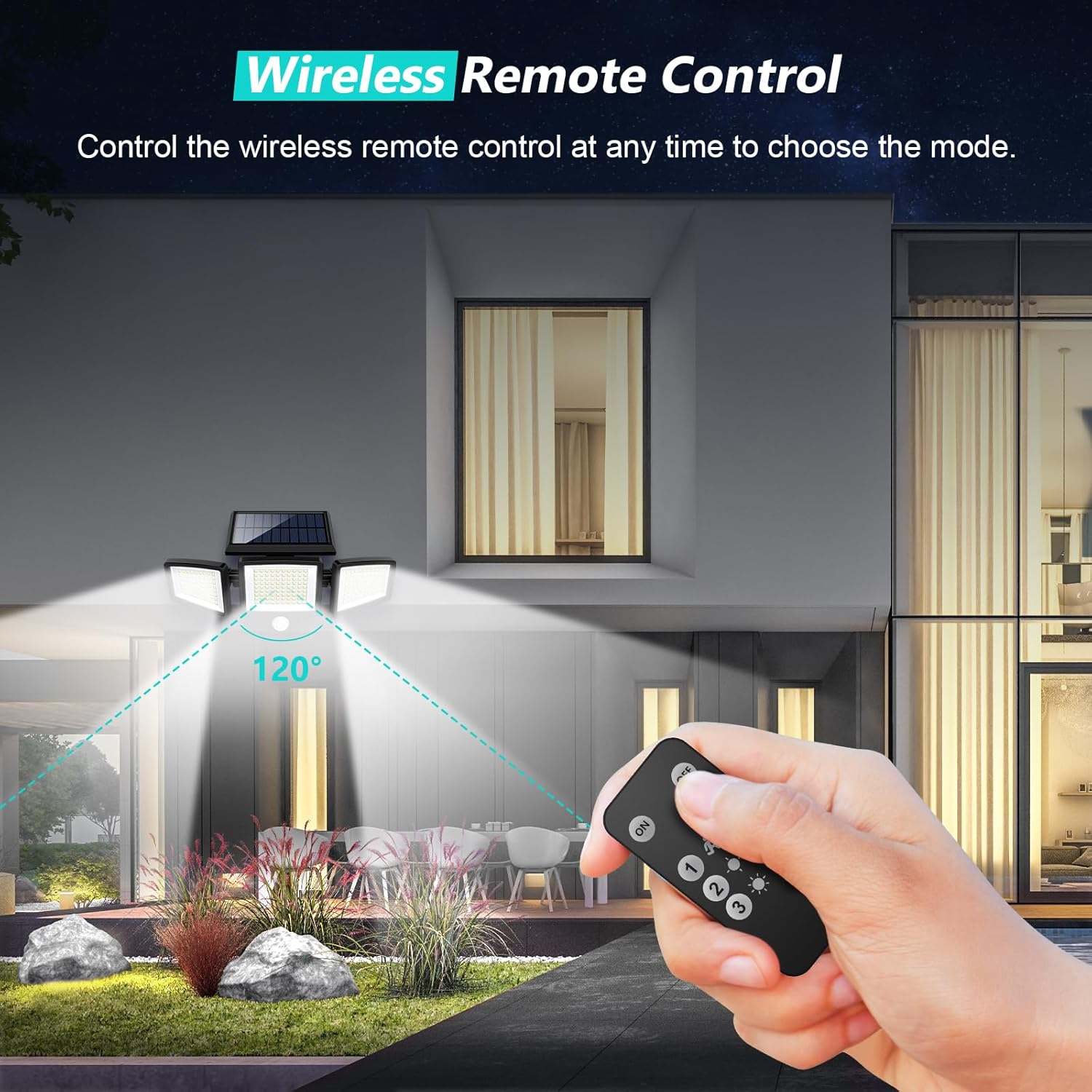
Security lighting is exactly what it sounds like: outdoor lights that make your property harder to approach undetected, either by triggering on motion — surprising anyone who walks up — or by keeping your yard bright enough all night that cameras can actually capture usable footage. The two main technology camps are solar-powered fixtures, which charge themselves from sunlight during the day and run on an internal battery at night with zero wiring required, and hardwired fixtures, which connect to your home’s electrical system and deliver perfectly consistent power regardless of weather or season. Neither is universally better. The right choice depends on where you live, what your cameras need, and how much installation work you’re willing to do. This comparison covers three specific products buyers keep evaluating side by side — the Tuffenough solar flood light, the MIHANI solar security light, and the LUTEC 72W hardwired three-head unit — plus a supporting look at the LEPOWER 38W hardwired fixture for buyers who want wired reliability at a lower entry cost.
Solar Security Lights: What Tuffenough and MIHANI Actually Deliver
The solar flood light category has matured rapidly. A fixture you might have dismissed five years ago as a dim novelty now routinely ships with 2,000–3,500 lumen outputs and motion sensors with claimed detection ranges exceeding 40 feet. Both the Tuffenough and MIHANI models sit in this upgraded tier.
Tuffenough Solar Flood Light
Tuffenough
$25.99
In stock on Amazon
Check price on AmazonTuffenough consistently earns enthusiastic first-impression reviews. Owners repeatedly describe being genuinely surprised by how bright the light is relative to what they expected from a solar unit — phrases like “way brighter than I thought” and “lit up the whole driveway” appear across aggregated owner feedback. One particularly instructive use case involves mounting Tuffenough lights specifically to extend a security camera’s effective detection range into a carport that previously sat in shadow. That is a sound integration strategy: cameras that cannot see motion in darkness fail to trigger their detection zones correctly, and supplemental flood lighting solves that problem without repositioning the camera or running new wiring. The Tuffenough’s wide-panel solar design and multi-head configuration make it adaptable for exactly that kind of targeted placement.
For buyers who want solar performance at a primary entry point without the cost of a hardwired installation, Tuffenough represents the strongest value position in the solar category. It works best in sun-reliable climates and at supplemental or secondary coverage positions everywhere else.
Tuffenough
$25.99
In stock on Amazon
Check price on AmazonMIHANI Solar Security Light
LUTEC
$31.99
In stock on Amazon
Check price on AmazonMIHANI earns similar brightness praise to Tuffenough, with owners in sun-rich regions reporting reliable all-night performance across the motion-trigger and continuous low-glow modes most current models include. Where MIHANI tends to differentiate in owner accounts is build quality perception — reviewers more frequently describe the housing as feeling solid and the mounting hardware as well-machined relative to entry-level solar competitors.
The critical caveat both solar brands share: the majority of strongly positive reviews are written in summer months or from climates with consistent sun exposure — the American Southwest, Southeast, and coastal California feature prominently. Buyers in the Pacific Northwest, Great Lakes region, or anywhere that sees extended cloud cover in fall and winter should treat solar brightness ratings as best-case figures. A fixture rated for 3,000 lumens under peak summer sun may deliver noticeably reduced brightness after two or more consecutive cloudy days as battery reserves deplete. SafeWise’s outdoor security lighting coverage (SafeWise Editorial Team, “Best Outdoor Security Lights,” safewise.com) notes this seasonal performance gap explicitly, recommending that buyers in low-solar-index climates either choose hardwired fixtures for primary perimeter coverage or treat solar units as supplemental rather than primary security lighting.
MIHANI is the right choice when you want solar convenience with a step up in build confidence — particularly for permanent-mount positions where you expect the fixture to stay in place for multiple seasons.
LUTEC
$31.99
In stock on Amazon
Check price on AmazonSolar vs. Hardwired: Side-by-Side Reality Check
| Factor | Tuffenough / MIHANI Solar | LUTEC 72W Hardwired |
|---|---|---|
| Brightness (claimed) | 2,000–3,500 lumens | 5,400–6,500 lumens |
| Winter performance risk | High in cloudy climates | None |
| Installation complexity | Low (mount and aim) | Moderate (requires electrical box) |
| 3-year operating cost | Low (no electricity draw) | Low–moderate (wattage-dependent) |
| All-night ambient mode | Model-dependent | Yes (dusk-to-dawn standard) |
LUTEC 72W Hardwired: The Feature No Spec Sheet Explains Well Enough
LUTEC 72W Three-Head Hardwired Flood Light
LEPOWER
$35.98
In stock on Amazon
Check price on AmazonThe LUTEC 72W three-head security flood light earns its place in this comparison not because it is the cheapest hardwired option or the brightest in absolute terms — it is neither — but because of a specific operational mode that turns out to be genuinely useful for perimeter security architecture.
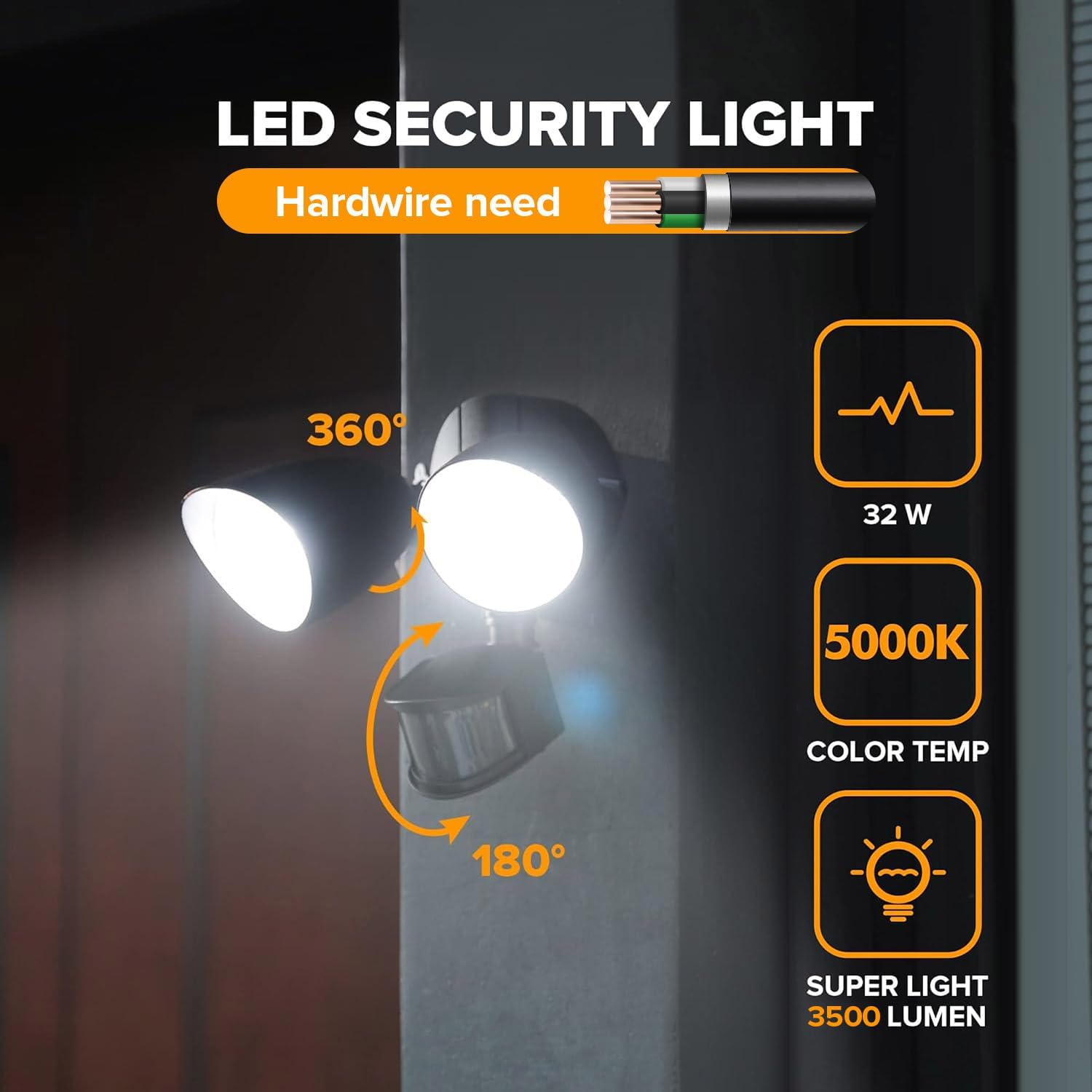
LUTEC includes a dusk-to-dawn ambient mode that holds the fixture at approximately 50% brightness from sunset to sunrise, then jumps to 100% output when the motion sensor triggers. Most buyers gloss over this in the specification sheet because it sounds minor. It is not. This mode enables a specific whole-perimeter strategy: the yard is never fully dark, which means camera footage has a usable baseline exposure throughout the night, and any motion event produces an obvious brightness surge that is visible in both live view and recorded clips. CNET’s outdoor security lighting coverage (CNET Reviews Team, “Best Outdoor Security Lights of 2025,” cnet.com) repeatedly surfaces the point that camera performance is directly tied to ambient light levels, and this dual-mode behavior is an elegant hardware solution to what many buyers attempt to solve with more expensive camera upgrades.
Tom’s Guide’s motion sensor light coverage (Tom’s Guide Staff, “Best Motion Sensor Lights,” tomsguide.com) notes that three-head flood configurations are particularly well-suited for corner-mount positions where a single-head fixture leaves blind spots. The LUTEC’s three independently adjustable heads provide meaningful aiming flexibility — each head can cover a separate zone — which matters when you need to cover a side yard, a driveway approach, and a backyard fence line from a single junction box.
One documented installation friction point: LUTEC flush-mount installation is specifically called out as difficult on older or deeper electrical junction boxes. The fixture’s backing plate does not sit flush when an existing box protrudes farther than standard modern depth, creating a gap that is both aesthetically problematic and a potential ingress point for insects or moisture. If your home was built before the 1980s or you are installing on an older outbuilding, measure your junction box depth before ordering. This is not a dealbreaker, but it is the kind of issue that turns a 45-minute install into a two-hour hardware-store trip.
For buyers who need reliable all-night ambient coverage that serves both deterrence and camera-quality goals, LUTEC 72W is the correct architecture — the dusk-to-dawn mode alone justifies the premium over simpler hardwired competitors.
LEPOWER
$35.98
In stock on Amazon
Check price on AmazonLEPOWER 38W: Hardwired Reliability at an Entry-Level Price
Not every installation point needs a 72W fixture drawing full power and light output. The LEPOWER 38W hardwired flood light occupies a practical middle position: it delivers consistent electrical-grid power — eliminating solar performance variability entirely — at a cost significantly below premium multi-head hardwired options. The characterization that appears most often in long-run owner accounts is a performance-to-cost framing rather than absolute brightness claims. For buyers who need hardwired reliability at a secondary access point — a side gate, a basement stairwell entry, a detached garage — the LEPOWER profile makes strong sense as a complement to a primary high-output fixture rather than a standalone perimeter light.
PCMag’s smart-home security system coverage (PCMag Labs, “The Best Smart Home Security Systems,” pcmag.com) consistently reinforces that layered security lighting — multiple fixtures at different output levels covering overlapping zones — outperforms a single high-lumen fixture with dark gaps on either side. The LEPOWER fits that layered architecture well, giving you hardwired consistency at positions where budget and output requirements are modest.
Tuffenough
$25.99
In stock on Amazon
Check price on AmazonHow to Aim Three-Head Security Lights Without Creating Blind Spots
Three-head fixtures are specifically designed for wide-area coverage, but they create a false sense of security if you aim all three heads at the same zone. The correct approach — consistent with installation guidance published by SafeWise (SafeWise Editorial Team, “Best Outdoor Security Lights,” safewise.com) — is to treat each head as its own distinct coverage assignment:
- Head 1: Primary approach path (driveway, main walkway, or gate)
- Head 2: Secondary approach or side yard
- Head 3: Camera coverage zone — aimed directly into the camera’s field of view to maximize footage exposure quality
Before finalizing aim positions, walk your perimeter at night with the fixture temporarily mounted and the motion sensor disabled. Most fixtures include a test or override mode that holds the light on continuously. Identify where shadows fall and adjust accordingly. The goal is overlapping coverage: each camera zone should have at least two light sources reaching it so that a single fixture going dark — depleted battery on a solar unit, a wiring fault on a hardwired unit — does not instantly create a blind spot.
Pay particular attention to the zone directly below and beside the fixture itself. A common error with multi-head floods is aiming all heads outward, leaving a dark pocket within 8–10 feet of the mount point. That close-in shadow is exactly where someone tampering with the fixture would stand.
Frequently Asked Questions
Do solar security lights work on cloudy days or in winter?
Yes, but with meaningful performance reduction during sustained cloud cover. Modern solar panels charge even under overcast skies, but at a fraction of their peak rate. After two or more consecutive cloudy days, battery reserves in most consumer solar security lights begin to affect brightness duration or maximum output. Buyers in the Pacific Northwest, upper Midwest, or anywhere with significant November–February cloud cover should either choose hardwired fixtures for primary perimeter positions or supplement solar units with at least one hardwired fixture at each critical entry point.
What is the real detection range of the Tuffenough and MIHANI motion sensors?
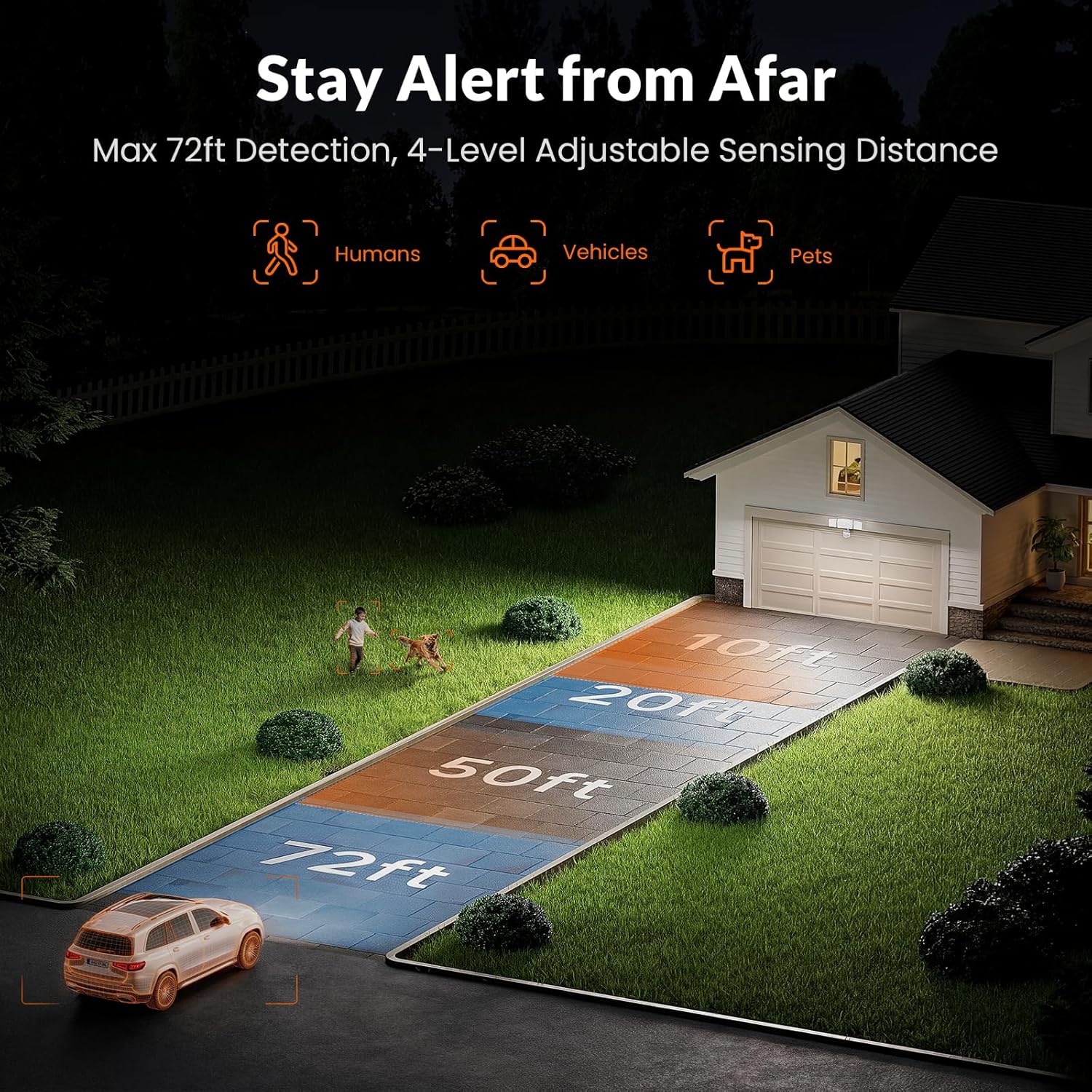
Both brands publish detection ranges in the 30–50 foot range, but real-world performance varies by mounting height, angle, and ambient temperature. Passive infrared sensors — the standard motion detection technology in these fixtures — detect heat differential between a moving body and the surrounding environment, so extreme cold or heat affects sensitivity. Owners across aggregated reviews report reliable triggering at 20–35 feet under typical residential conditions. Mounting at 8–10 feet and angling the sensor downward at roughly 30–45 degrees from horizontal tends to produce the best results, consistent with installation guidance from Tom’s Guide’s motion sensor light coverage (Tom’s Guide Staff, “Best Motion Sensor Lights,” tomsguide.com).
Can I set LUTEC lights to stay on dimly all night and brighten on motion?
Yes. This is the dusk-to-dawn ambient mode described in the LUTEC section above. It is available on the LUTEC 72W model and is selected via a physical switch on the fixture body — no app, hub, or smart-home integration required. The light holds at approximately 50% brightness all night and surges to 100% on motion detection. It is one of the more practically useful features in the hardwired flood light category and a primary reason to choose LUTEC over simpler hardwired competitors when whole-perimeter ambient coverage is the goal.
Do I need an electrician to install a hardwired three-head flood light?
For a replacement installation — swapping an existing outdoor fixture at an existing junction box — most competent DIYers can handle it without an electrician. The work involves turning off the circuit breaker, confirming the box is rated for the fixture’s weight, and connecting three wires (hot, neutral, ground). If you are running a new circuit from the panel or adding a junction box where none currently exists, that work requires a licensed electrician in most jurisdictions and should be permitted. Budget extra time for LUTEC installation if your existing box is older or non-standard depth, as noted above.
Will a solar security light stay bright all night or only trigger on motion?
Most current solar security lights — including the Tuffenough and MIHANI models — offer multiple modes selectable via a physical switch or small remote: motion-only trigger, continuous low glow with motion boost, or always-on. The motion-trigger-only mode is the default and the most battery-efficient. Continuous always-on mode depletes the battery significantly faster, which is particularly problematic in low-sun seasons. For reliable all-night ambient coverage, a hardwired fixture with a dedicated dusk-to-dawn circuit — specifically the LUTEC 72W’s ambient mode — is the more dependable long-term solution.
The Decision Rule
If you are in a sun-reliable climate and need coverage at secondary or supplemental positions — a carport, side yard, or detached garage — solar fixtures like the Tuffenough or MIHANI give you strong brightness with zero wiring work and zero ongoing electricity cost. They integrate well alongside cameras as range-extenders into shadow zones that would otherwise require running conduit.
If you are in the Pacific Northwest, a northern state, or anywhere with significant winter cloud cover — or if you need reliable all-night ambient lighting to support camera image quality rather than just motion-triggered deterrence — the LUTEC 72W hardwired unit is the correct architecture. Its dusk-to-dawn ambient mode is a genuine differentiator that improves your camera system’s effectiveness without additional hardware investment. The LEPOWER 38W is the right complement for secondary hardwired positions where budget matters more than maximum output.
The most resilient whole-yard setup combines both technologies: hardwired fixtures at primary entry points and camera coverage zones, solar units filling in at secondary positions where running wire would be expensive or disruptive. That layered approach — consistent electrical baseline with solar supplementation — is what CNET’s outdoor security lighting coverage (CNET Reviews Team, “Best Outdoor Security Lights of 2025,” cnet.com) and SafeWise’s outdoor lighting guides consistently describe as the practical standard for homeowners who treat lighting as an integrated component of a security system rather than a standalone product purchase.